

Most advice about Fernando County tree pruning is about how much to take off. Far less is said about the single cut itself, which is where a tree either heals or starts to rot from the inside. Follow one limb from the ground to the saw and you learn most of what matters. That is the mindset behind the work at Trent’s Tree Service The Neighborhood Arborist LLC, a Brooksville outfit where ISA Certified Arborists make the calls and the owner stays involved on the job. Here is the whole journey of one branch, in the order it happens.
Before the saw starts, someone has to answer why
University of Florida horticulturists make a blunt observation about landscape pruning. Much of what gets done today accomplishes little for the owner or the tree, and money is wasted removing the wrong branches. The International Society of Arboriculture puts the remedy simply in its tree pruning guide. No branch should be cut without a reason, because every cut can change how the tree grows. For established trees the reason is usually to reduce risk, preserve good structure, create clearance, or improve appearance, and each goal points toward a different technique.
- Crown cleaning removes dead, diseased, crossing, or rubbing branches.
- Thinning opens up dense clusters so wind and light pass through.
- Raising lifts lower limbs away from roofs, sidewalks, and trucks.
- Reduction shortens a branch back to a lateral limb that can take over as the new tip.
None of these has to be applied evenly. One side of a crown can be reduced to relieve a weak union while the other side is simply raised for clearance. A tree is a set of separate problems, not one big shape to be trimmed round.
Finding the spot that heals
Look at where a limb meets the trunk and you will see a slightly swollen ring, the branch collar, with a ridge of bark running up into the crotch. That collar holds the tree’s natural defenses against decay. A proper final cut lands just outside it, parallel to the trunk line and leaving the collar intact.
Two mistakes dominate. A flush cut slices into the collar and opens a wound the tree cannot seal. A long stub leaves dead wood that rots back into the trunk. Both are common in yards where someone worked quickly with a ladder and a chainsaw.
The three cuts, in order
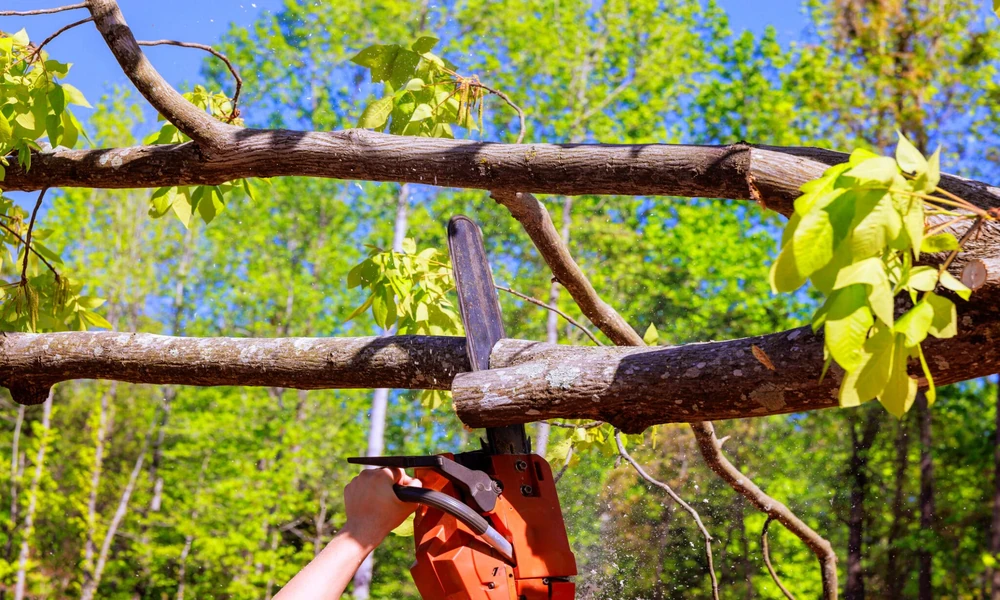
Any branch heavy enough to tear bark on its way down gets the same sequence.
- A shallow undercut a foot or so out from the trunk, stopping about a third of the way through.
- A second cut from the top, slightly farther out, which drops the limb cleanly.
- The final cut just outside the branch collar, removing the remaining stub with no weight left to rip the bark.
The undercut is what makes the sequence work. Without it, a falling limb peels a strip of bark down the trunk, and that wound can be far larger than the cut itself.
The quarter rule and where it bends
How much to remove is the question everyone asks. The ANSI A300 pruning standard recommends taking off less than twenty five percent of the foliage in a single visit, and UF’s guide to pruning shade trees explains that this is an average across all ages and health. Younger, vigorous trees tolerate more. Older or stressed ones tolerate less.
The same guide points out a useful exception. A large dose is sometimes justified on one troublesome piece, such as a dominant codominant stem that needs to be subordinated, while the rest of the crown gets only a light touch. The guide also notes that sprouts after structural pruning are often an asset, because they help the tree resist decay behind cuts. In other words, the number is a guardrail and not a command.
What topping steals
Topping, where a tree is sheared back to stubs, is the practice reputable arborists refuse. It leaves large wounds that decay, and the weak, fast sprouts that follow attach poorly and break easily, often in the same storm the topping was meant to protect against. Lion tailing, stripping the inner branches and leaving foliage only at the ends, shifts weight outward and has the same effect. Wound paint is another habit that university guidance discourages, since trees seal wounds on their own.
The tree may look tidy for a season. The cost shows up later, in rot, brittle regrowth, and sometimes in removal.
Timing in a state that never fully rests
Florida trees do not follow the neat winter dormancy calendar you read about in northern guides. Light pruning and cleanup work can happen most of the year. Heavier structural work is best planned for before storm season, and UF/IFAS cautions against pruning or removing trees once a hurricane watch has been issued. Cuttings left at the curb become hazards. Late October is a sensible time to plan, since the busiest weeks are behind us and crews have room to work carefully.
Palms are their own category. Dead fronds and old fruit stalks can come off, and that is largely the end of it.
Reading a proposal before you sign it
A good pruning estimate should tell you what will be cut and why. Ask which of the methods above is planned, roughly what share of the crown will be removed, and whether the crew follows ANSI A300 standards. Ask for proof of liability insurance and workers’ compensation. Florida does not license arborists, so ISA certification is one of the few credentials that can be checked, and the Florida chapter of the ISA also recommends getting more than one written proposal.
Watch for any bid that involves topping, or one that is dramatically cheaper than the rest. The cuts you approve of this season will still be shaping the tree a decade from now, which is a long time to live with a rushed afternoon.
